
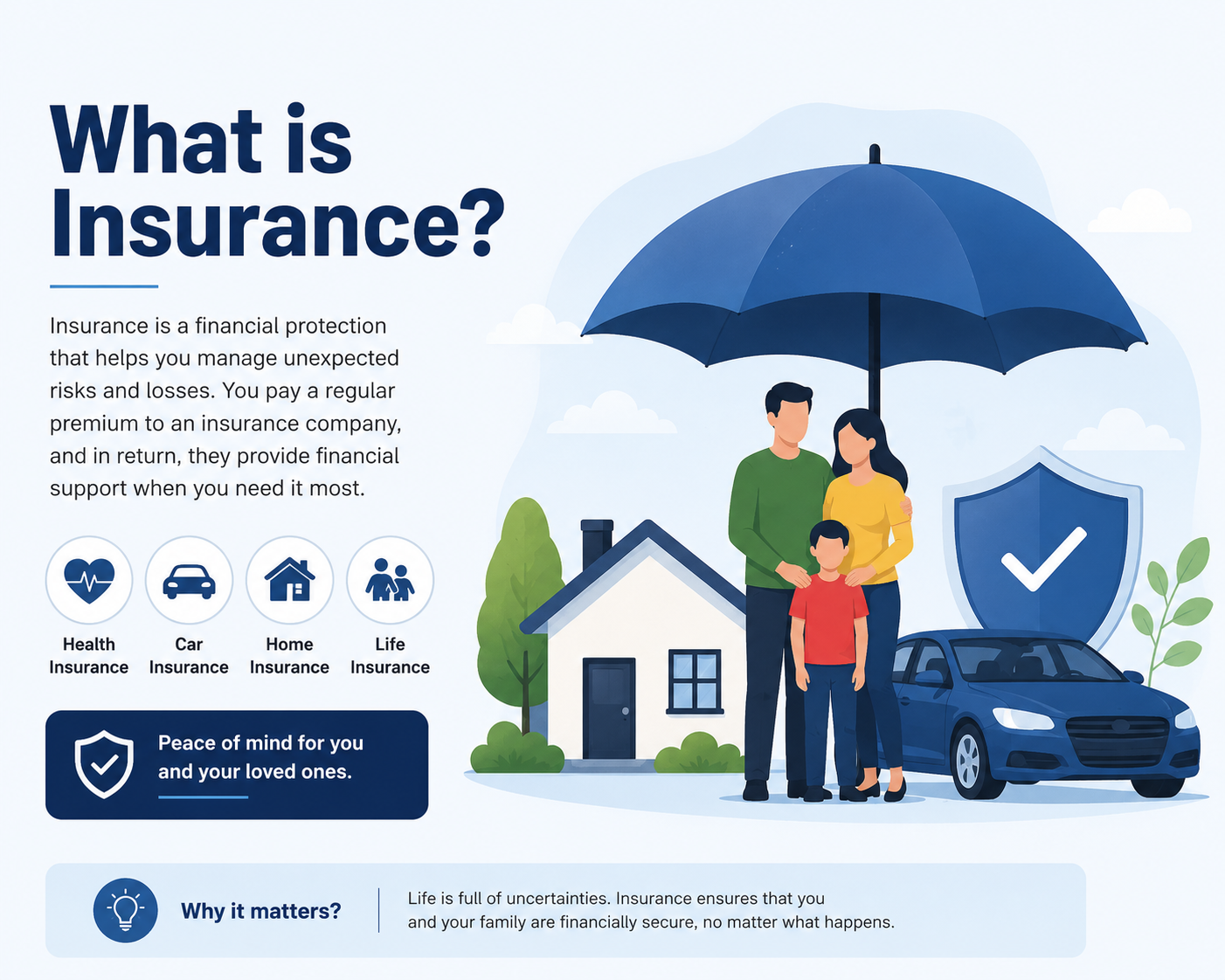
What is Insurance?
Insurance is a financial protection system that helps individuals, families, and businesses manage the financial impact of unexpected events. In simple words, you pay a relatively small amount of money, known as a premium, to an insurance company. In return, the company agrees to provide financial compensation when a covered event causes a loss, such as an accident, illness, property damage, theft, or death.
Life is unpredictable. A serious medical emergency can result in expensive hospital bills, a car accident can require costly repairs, and a fire can destroy valuable property within minutes. Insurance cannot prevent these events from happening, but it can reduce their financial consequences. This makes insurance an important part of personal financial planning and risk management.
For Insurance understand it like:
Insurance is a legal and financial agreement between an individual or organization and an insurance company. The person or business purchasing insurance is generally called the policyholder, while the insurance company agrees to provide financial protection according to the terms of the policy.
The policyholder pays a premium at regular intervals, such as monthly, quarterly, or annually. If a covered event occurs, the policyholder can submit a claim to the insurance company. After reviewing the claim and confirming that the loss is covered, the insurer pays compensation according to the policy’s terms, limits, and conditions.
For example, imagine that you own a car and purchase auto insurance. You pay a premium to keep your policy active. If you later have an accident that is covered by your policy, the insurance company may pay for eligible repair costs or other covered expenses, depending on the type of coverage you purchased.
Therefore, the basic purpose of insurance is simple: you pay a manageable amount today to protect yourself from potentially large financial losses in the future.
How Does Insurance Work?
Insurance works primarily through the concept of risk pooling. Many people face the possibility of unexpected losses, but not everyone will experience a major loss at the same time.
Insurance companies collect premiums from a large number of policyholders and use those funds to pay covered claims. Because the risk is spread across a large group, the financial burden of an individual loss can be managed more effectively.
For example, thousands of people may purchase car insurance during a year. Most policyholders may not have a major accident, while a smaller number may file claims for covered accidents. The insurer uses the premiums collected from the larger pool of policyholders to help pay eligible claims.
Insurance companies also use statistical data, risk assessment, underwriting, and actuarial calculations to estimate how likely certain losses are and how much those losses may cost. Based on these calculations, insurers determine premiums and coverage conditions.
It is important to understand that insurance does not mean the company will pay for every loss. Only losses covered by the policy are generally eligible for compensation, and exclusions, deductibles, limits, and other conditions may apply.
Important Insurance Terms You Should Know
Understanding basic insurance terminology makes it easier to compare policies and understand what you are actually buying.
Premium:
A premium is the amount you pay to an insurance company to maintain your insurance coverage. Depending on the policy, premiums may be paid monthly, quarterly, or annually.
Policy:
An insurance policy is the legal contract between the policyholder and the insurance company. It explains the coverage provided, exclusions, limits, premiums, deductibles, and responsibilities of both parties.
Deductible:
A deductible is the amount you generally have to pay yourself before the insurer pays for a covered claim. For example, if you have a $500 deductible and an eligible covered loss of $3,000, you may be responsible for the first $500, while the insurer may cover the remaining eligible amount, subject to the policy terms.
Claim:
A claim is a formal request submitted to an insurance company asking it to provide payment or benefits for a covered loss.
Coverage Limit:
A coverage limit is the maximum amount an insurance company will pay for a particular covered loss or category of coverage under the policy.
Exclusion:
An exclusion is something the insurance policy specifically does not cover. Understanding exclusions is extremely important because a policy that appears inexpensive may provide limited protection.
Major Types of Insurance
Insurance is available in many forms because people and businesses face different types of risks. The most common types include health, life, auto, property, liability, and business insurance.
1. Health Insurance
Health insurance helps cover eligible healthcare expenses, such as hospitalization, medical treatment, doctor consultations, tests, or medicines, depending on the policy.
Without adequate health coverage, a serious illness or medical emergency can place significant pressure on a family’s savings. Health insurance can therefore help people manage unexpected healthcare costs and access necessary medical services.
2. Life Insurance
Life insurance provides financial benefits to designated beneficiaries after the insured person’s death, subject to the policy terms.
Life insurance can be particularly important for people who have dependents. If a family’s primary income earner dies, the resulting loss of income can make it difficult to pay for housing, education, daily expenses, debts, and other financial obligations. Life insurance can provide a financial cushion during such a difficult period.
3. Auto Insurance
Auto insurance provides financial protection against certain risks associated with owning and operating a vehicle. Depending on the policy and applicable laws, it may cover vehicle damage, injuries, third-party liability, theft, or other losses.
Auto insurance is particularly important because accidents can create both property-related and legal liabilities.
4. Homeowners Insurance
Homeowners insurance can protect a home and certain personal belongings against covered risks such as fire, theft, storms, or other specified events.
A home is often one of the most valuable assets a person owns. Insurance can help reduce the financial impact of serious property damage.
5. Renters Insurance
People who rent a home may also benefit from renters insurance. While the landlord generally insures the building itself, renters insurance can help protect the tenant’s personal belongings against certain covered events. Depending on the policy, it may also include liability protection.
6. Disability Insurance
Disability insurance can replace part of a person’s income if an illness or injury prevents them from working, subject to the policy’s conditions.
Because income is one of the most important financial resources for many households, protecting the ability to earn that income can be just as important as protecting physical property.
7. Liability Insurance
Liability insurance helps protect an individual or business from certain financial responsibilities arising when they are legally liable for injury, property damage, or other covered harm to another person.
Liability claims can sometimes become extremely expensive, making this type of protection important for both individuals and businesses.
8. Travel Insurance
Travel insurance can provide protection against certain unexpected problems during a trip. Depending on the policy, this may include covered medical emergencies, trip cancellation or interruption, lost baggage, or travel delays.
Why Is Insurance Important?
The main importance of insurance is financial protection against uncertainty. Nobody can predict exactly when an accident, illness, natural disaster, theft, or other unexpected event will occur.
Without insurance, a major loss could force someone to use their savings, sell assets, borrow money, or take on substantial debt. Insurance can reduce the financial shock by transferring certain risks to an insurer in exchange for a premium.
Insurance also provides greater financial confidence. A person may feel more comfortable owning a vehicle, purchasing a home, starting a business, or planning for the future when major risks are appropriately protected.
However, insurance should not be viewed as a way to make money from losses. Its primary purpose is risk management and financial protection.
How to Choose the Right Insurance Policy
Choosing insurance should not be based only on finding the cheapest premium. A low-cost policy may provide insufficient coverage, while a more expensive policy may offer protection that you do not actually need.
Start by identifying your biggest financial risks. Consider your income, dependents, assets, debts, health needs, lifestyle, and legal requirements.
Next, compare the coverage offered by different policies. Pay close attention to the premium, deductible, coverage limits, exclusions, waiting periods, claim procedures, and policy conditions.
You should also research the insurer’s reputation, customer service, claims process, and financial strength where reliable information is available. Most importantly, read the policy documents carefully instead of relying only on advertisements or sales explanations.
It is also wise to review your insurance periodically. Your financial situation can change when you get married, have children, purchase a home, change jobs, start a business, or acquire significant assets. Your insurance coverage should be updated when your risks and responsibilities change.
Final Thoughts: Why Insurance Matters in Financial Planning
Insurance is one of the fundamental tools of financial risk management. It cannot eliminate uncertainty, but it can make unexpected financial losses easier to manage.
The basic idea is straightforward: pay a predictable premium to protect yourself against potentially unpredictable and expensive losses. By pooling risks among many policyholders, insurance companies can provide financial support to people who experience covered events.
From health and life insurance to auto, home, renters, disability, liability, and travel insurance, each type of coverage addresses a different financial risk. The right insurance strategy depends on an individual’s circumstances, financial responsibilities, assets, and level of risk.
Ultimately, good insurance is not simply about buying the most coverage or choosing the cheapest policy. It is about finding the right balance between protection, affordability, and actual financial needs. When carefully selected and regularly reviewed, insurance can help protect your savings, income, assets, family, and long-term financial goals from unexpected events.